
Matchbook bought Betdaq, then shut its order book within a week
Matchbook completed its acquisition of rival betting exchange Betdaq for an undisclosed sum, reported on 15 October 2026 by Yogonet, and Betdaq stayed open for trading only until 21 October. Customer accounts remain open for withdrawals until 4 November. Six trading days, and one of the oldest exchanges in the business stopped matching bets.
Betdaq was not a minor operation. Financier Dermot Desmond founded it in 2000, making it one of the earliest betting exchanges anywhere. He sold it to Ladbrokes in 2013 for €30 million (US$34 million), then bought it back from Ladbrokes owner Entain eight years later. Matchbook, founded in 2004, also runs easyBet, developed with Sir Stelios Haji-Ioannou’s easyGroup, and has launched ADI PredictStreet on its platform through a partnership; ADI PredictStreet is a separate prediction market operator and FIFA World Cup 2026 partner, not a Matchbook product. The Racing Post reports the deal also takes in Racecourse Data Technologies, which supplies hardware, betting software and support to on-course bookmakers and lets them hedge positions through Betdaq.
If none of that means much to you, that is the point of this piece. Exchanges have never been a mainstream product for Indian bettors, so a deal between two of them reads like news from another sport entirely. Here is the exchange model explained from scratch, and an honest look at the claim both companies are making about it.
What a betting exchange actually is
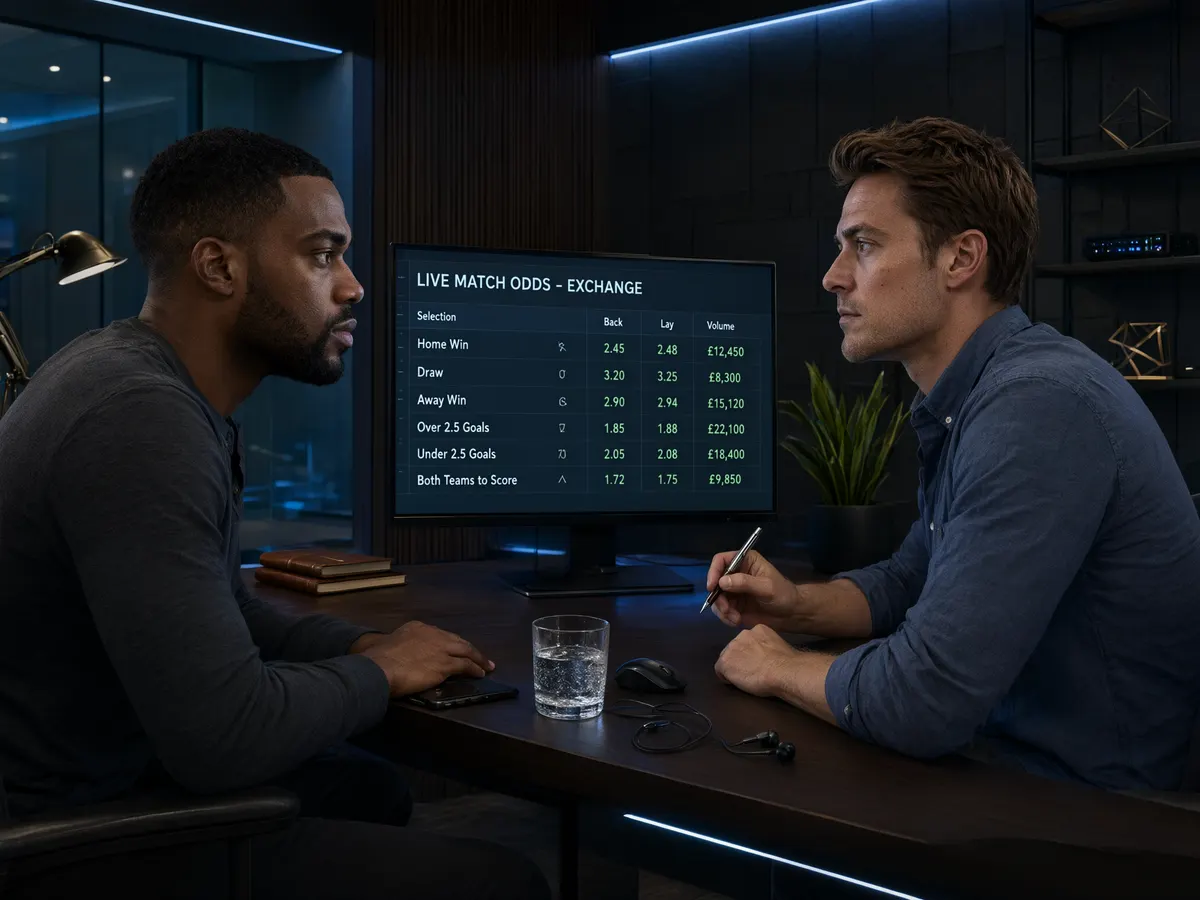
A betting exchange is a marketplace where bettors wager against each other rather than against a bookmaker. The platform does not set prices, does not take the other side of your bet, and does not care who wins. It matches two opposing opinions and charges a commission on the winner’s net profit.
That is peer-to-peer betting. One person wants India to win the toss at 2.00; another is willing to take the opposite side at the same price. The exchange pairs them, holds both stakes, and settles after the result. Everything sits in an order book, exactly like a share-trading screen: unmatched offers queue at each price, and the amount available at each price is visible before you commit.
Two actions replace the single “bet” button you know from a sportsbook. Backing means betting that something will happen. Laying means betting that it will not, which is the bookmaker’s traditional job handed to any user who wants it. On an exchange you can be the punter or the house, market by market, and you can be both in the same event at different prices.
Exchange versus sportsbook: where the money comes from
The real difference is not the interface, it is how the operator gets paid. A sportsbook earns from the margin baked into its prices. An exchange earns a commission on winnings and otherwise takes no view on the outcome.
| Feature | Sportsbook | Betting exchange |
|---|---|---|
| Who sets the odds | The bookmaker’s traders and pricing models | Users, through competing back and lay offers |
| How the operator earns | Overround built into every price | Commission on net winnings |
| Where the money to pay you comes from | The bookmaker’s own balance sheet | The liability posted by the bettor on the other side |
| Can you bet against an outcome | Only if the book offers the opposite selection | Yes, by laying any selection |
| Limits on winning accounts | Stakes often cut or accounts restricted | Limited by available liquidity, not by the operator’s appetite |
| Behaviour on niche markets | Priced, but with a wider margin | May have little or no money available to match |
Who sets the price
On an exchange, nobody with an office does. A price exists because somebody is prepared to lay it and somebody else is prepared to back it. Professional market makers do post prices on the bigger markets, which is why horse racing and Premier League match odds look tight and a third-tier basketball total looks empty.
Commission against the overround
Take a genuine 50/50 market. A sportsbook typically offers 1.91 on each side. Those two prices imply 52.36% each, summing to a total implied probability of 104.72%, which means roughly 4.72% of overround, the bookmaker’s margin, sits on top of the true probabilities. An exchange can show 2.00 on both sides, a 100% book, because no margin is added. The operator instead takes a cut of your profit when you win.
Say commission is 2% of net winnings, which is in the range exchanges generally charge. Back ₹1,000 at 2.00 and win, and you keep ₹980 of profit, an effective price of 1.98 against the sportsbook’s 1.91. On that market the exchange is clearly better. Change the numbers and the conclusion can flip: commission is charged on winnings, so the higher the price you take, the more rupees the percentage removes, and a tight-priced favourite with thin liquidity can leave you worse off than a promotional sportsbook price. The headline “exchanges offer better odds” is true more often than not, not true always.
Back and lay, with the numbers
Back ₹1,000 at 3.00 and you win ₹2,000 profit if the selection comes in, or ₹1,960 after 2% commission. Lose, and you are out ₹1,000. That is the familiar bet.
Now lay the same selection at 3.00 to a backer staking ₹1,000. Your liability is the backer’s stake multiplied by odds minus one: ₹1,000 × 2.00 = ₹2,000. If the selection loses, you collect the backer’s ₹1,000, which is ₹980 after commission. If it wins, you pay out ₹2,000.
Read those two paragraphs together and you can see the trap. Laying short-priced favourites looks like easy money because you win small amounts often. Laying long shots looks mad, because at 11.00 a ₹1,000 lay carries ₹10,000 of liability. New exchange users routinely misjudge this and post liabilities they would never have accepted as a stake. The exchange will not stop you; it only checks that the money is in your account.
Does combining two exchanges really deepen the pool?
Matchbook Chief Executive Ronan McDonagh said the combined exchanges were expected to offer better prices and deeper liquidity than either platform could provide independently, and that the deal “deepens the pool at the heart of everything we build”. The structural logic holds. An order book works better the more orders sit in it, because a market with two bettors is a market where nothing gets matched.
What the available information does not support is any estimate of how much better. No matched volumes, no active-user counts and no deal price were disclosed. Liquidity does not transfer with a purchase, it transfers with customers, and some Betdaq users with six days’ notice will have moved to whatever venue they already trust rather than to Matchbook. Treat “deeper liquidity” as a reasonable expectation, not a measured outcome.
There is a cost on the other side of the ledger that neither company has reason to mention. Exchange bettors have long compared prices across venues and taken the best available; one fewer order book means one fewer price to compare against. McDonagh’s stated aim is “making the exchange first choice”, and on the quarter-century view he is right that peer-to-peer pricing has spread. Whether a market with fewer exchanges in it serves the bettor better than a market with more is the question this deal leaves open.
What exchanges are good at, and what they are not
- Prices on liquid markets are usually sharper than a sportsbook’s, because no margin is added to them.
- You can bet against outcomes, which covers positions a sportsbook simply does not sell.
- You can trade in and out of a position before the event settles, locking a profit or a loss at the current price.
- Winning accounts are generally not restricted the way sportsbook accounts are.
- Commission eats part of every win, so the quoted price is never the price you receive.
- Niche markets can be close to empty, leaving good offers unmatched at any size that matters.
- The learning curve is steep. Liability, matched and unmatched stakes, and partial matching all need understanding before you risk money.
- None of it changes the fundamentals of sports betting odds. Better pricing narrows the operator’s cut; it does not make a losing selection a winner.
Where this leaves bettors in India
Betting exchanges are not an established, locally regulated product in India, and the legality of online sports wagering varies by state and remains unsettled for several forms of betting. Some states prohibit it outright, others regulate specific activities, and much of the online market is served from offshore. Nothing here should be read as advice that any particular platform is lawful for you to use. Check the rules that apply in your own state, and if the position is unclear, take professional advice rather than a forum’s word for it.
If you do look at an exchange, four things are worth verifying before any money moves: how much is actually matched on the specific market you want to bet, the commission rate and whether it varies by sport or volume, the withdrawal and verification terms, and the platform’s legal availability where you live. The Betdaq timeline is a reminder that an account is only as accessible as the operator’s own plans allow.
And keep the arithmetic in view. An exchange narrows the operator’s take; it does not remove the fact that most bettors lose over time. Set a deposit limit, bet only money you can afford to lose, and use the self-exclusion and cool-off tools any serious platform provides. If betting has stopped feeling like a choice, stop and seek help.