
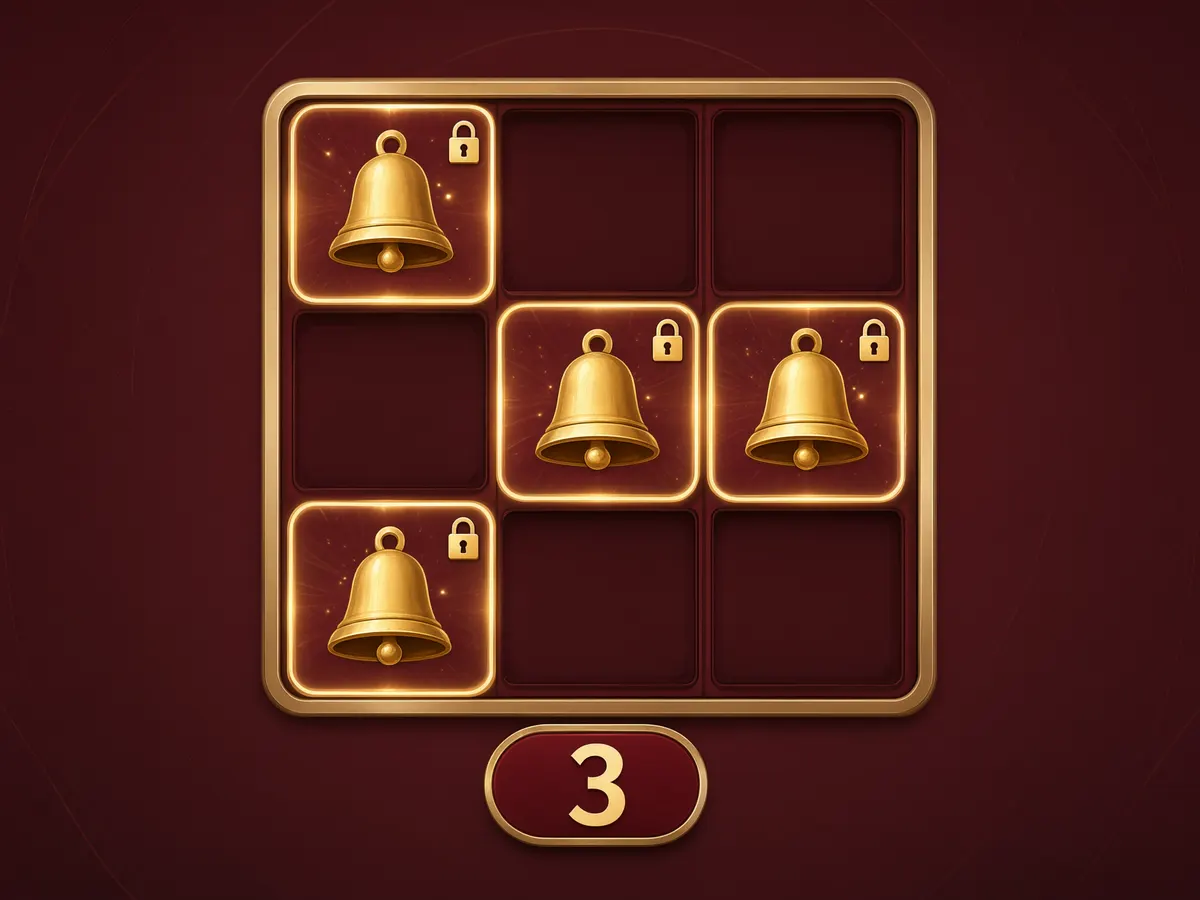
What the hold and win bonus feature actually does
If you have ever played a slot where certain symbols stick in place while the empty positions spin again, you already know the hold and win bonus feature. The question is what those respins are really counting, and why a supplier bothers to rebuild a format that already works.
A hold and win bonus feature is a respin round in which special symbols lock into their positions and only the remaining, unfilled cells spin again, with a fixed respin counter that resets every time another special symbol lands. Playson released 3 Roaring Bells: Hold and Win on 15 October 2026 with a reworked version of this round, adding three upgrade features and four in-game jackpots to a mechanic the supplier itself describes as retention-proven.
Most players will tell you a revamped bonus makes a slot more interesting, and they are right. The usual reason given, that extra features add value, is not. Features rearrange value; they rarely create it.
How the respin loop works, step by step
The hold and win mechanic runs on one rule: lock what qualifies, respin the rest, and keep going while new qualifying symbols keep arriving.
- Enough special symbols land in the base game to trigger the round. The threshold is set in the paytable and differs between games.
- Those symbols lock in place. In most versions they carry a value: a coin amount, a multiplier, or a jackpot tag.
- All other positions clear and respin. The player is given a fixed number of respins, commonly three.
- Each respin pays attention to one thing only, whether a new special symbol lands.
- When the round closes, the locked values are totalled and paid as a single amount.
When the respin counter resets
Any new special symbol resets the counter back to its starting figure. Land one on the second of three respins and you are back to three, with that symbol now locked for the rest of the round. This is why a hold and win round can run for two spins or for twenty: the length is not a fixed quantity, it is a chain that continues while the grid keeps feeding it.
How the feature ends
Two conditions close the round. Either the respins run out without a new special symbol landing, or every position on the grid fills. A full grid fill usually carries its own reward in these formats, often the largest jackpot on the paytable, which is also the rarest outcome by a wide margin.
Note what the counter does not do. It does not track progress towards anything, it does not get more generous as the round goes on, and the RNG behind it has no memory of the respins already used. Two respins left is not “almost there”; it is two independent chances at the same probability as the first.
What Playson changed in 3 Roaring Bells
The revamp centres on three upgrade features, each tied to a different coloured Special Bell, plus a collection system in the main game. Multi-coloured Bells that land during base play are collected by their matching Bells positioned above the reel set. When one or more Special Bells land, bonus play can be triggered randomly with one or more of the upgrades active.
| Upgrade | Triggered by | What it changes |
|---|---|---|
| Expand | Red Special Bell | Two additional rows are added to the game field |
| Double | Green Special Bell | Marks four cells; symbol values landing there are doubled. With Expand also active, six cells are marked |
| Extra | Blue Special Bell | Takes effect at the point the Bonus Game ends |
The announcement material available does not spell out the full working of the Extra feature beyond its trigger and the fact that it acts as the Bonus Game closes, so the in-game paytable is the place to confirm it rather than any second-hand summary, including this one. Playson also lists four in-game jackpots in the release. Published RTP and volatility figures are not stated in the announcement, which matters more than it sounds, and the next section explains why.
What the upgrade triggers change about the round
In a standard hold and win, the trigger is a count: land the required number of special symbols and the round begins in its only configuration. Here the colour of the Special Bell decides which upgrade is attached, and more than one can apply to the same round. The result is that two bonus rounds in the same game can be structurally different, not just differently lucky. A round running Expand has a larger grid than one that is not, which changes how many positions need filling before the round can complete.
Why upgrades move volatility without moving RTP
Feature upgrades change the shape of a game’s returns, not their long-run size. RTP is a design target, set by the mathematician and held roughly constant while the features are tuned. If a round can now double values in six marked cells, something elsewhere in the model has to give: a lower trigger rate, lower average coin values, a harder grid fill, or all three.
That is the trade-off with no clean answer. At a fixed RTP, hit frequency and payout ceiling pull against each other. You cannot add a richer top end and keep the same rhythm of small wins. The honest description of a feature upgrade is redistribution: money moves from the frequent, forgettable outcomes towards the rare, memorable ones. Whether that is an improvement depends entirely on which kind of session you tolerate.
Expand is a good illustration. Two extra rows give the round more positions to collect in, which raises the possible total. They also mean more cells must fill before the grid completes, so the biggest outcome in the format becomes harder to reach even as the room for collection grows. Neither effect cancels the other neatly, and without the published maths nobody outside Playson can say which dominates. Treat any article that tells you confidently is guessing.
Where hold and win sits next to free spins and cluster pays
Free spin rounds give you spins; hold and win gives you positions. In a free spins bonus, each spin is a fresh evaluation of the whole grid against the paylines, and the round has a fixed length known from the start, modified only by retriggers. Values do not accumulate on the board, they accumulate in your balance.
Cluster and cascade mechanics work in the opposite direction again. Winning symbols are removed, new ones drop in, and the chain continues while wins keep appearing, usually with a rising multiplier. The tension there sits inside a single spin.
Slot bonus respins of the hold and win kind are the only one of the three where the board state carries forward and the player can see the total building, cell by cell. That visibility is the format’s real appeal, and probably the actual reason it retains players so well. It is also why a blank respin stings more here than a blank free spin does.
What a hold and win round realistically feels like
Expect short, lopsided bursts. Most rounds end quickly, having locked a handful of modest values; a small minority chain several resets together and produce the figures that make the format worth building. There is no guaranteed payout, and a triggered bonus can return less than the stake that bought the spin which triggered it.
For bankroll pacing, the practical consequence is that base game stretches between bonuses can be long and flat, so a session budget sized for the average spin will not survive a run of them. Set a deposit or loss limit before you start, decide in advance how long a session runs, and use the operator’s limit and cool-off tools if a session is running past what you planned. Slots are entertainment with a built-in house edge; no feature set, upgrade symbol or respin pattern changes that.
Playson’s new slot release is a reasonable prompt to understand this mechanic properly, because the hold and win format now turns up across most major suppliers’ catalogues in some form. What the 3 Roaring Bells revamp genuinely decides is the texture of the variance, not the outcome of any round. Whether that texture suits you is not something a feature list can answer, and the paytable in the game itself is the only document that settles the specifics.