
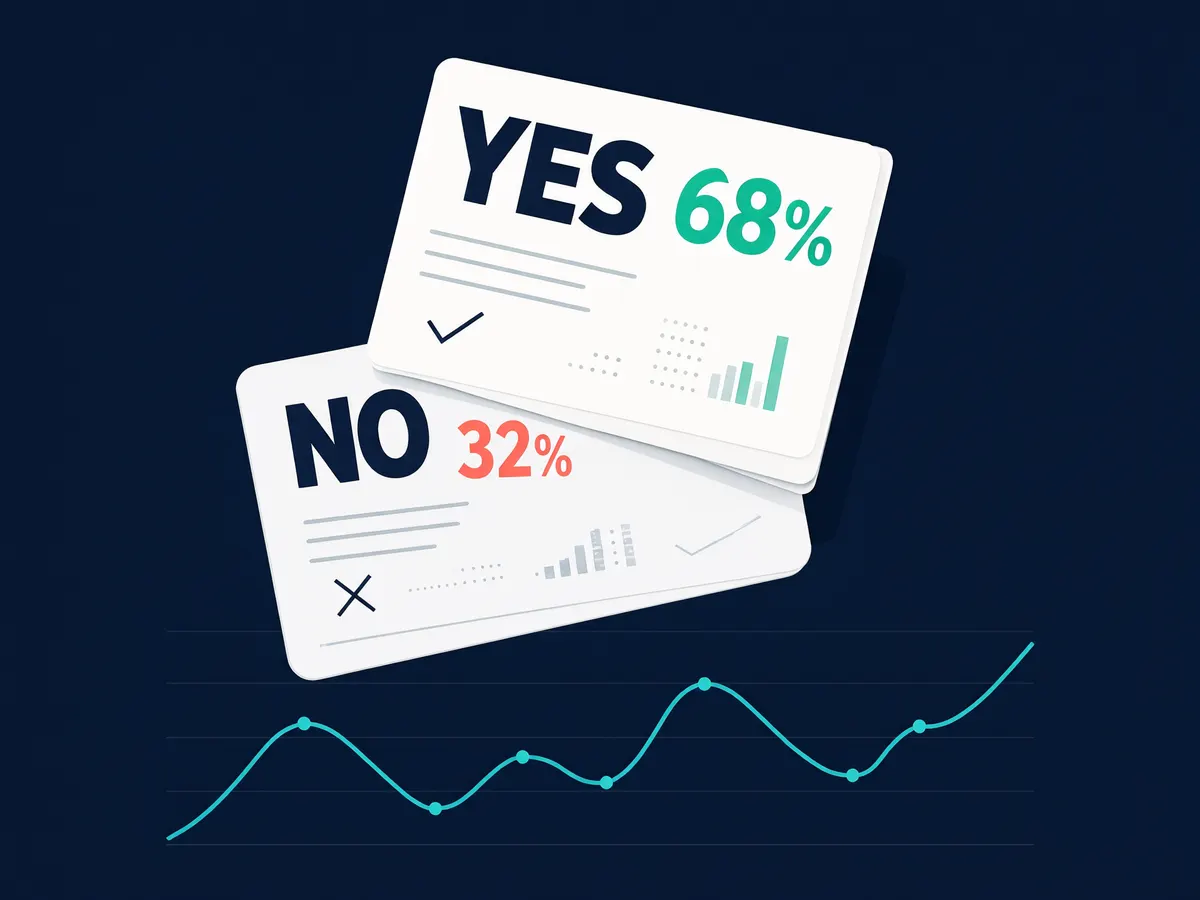
Is this betting, or is it trading?
If you have seen prediction markets in the news and quietly concluded “that is just betting with extra steps”, you are mostly right. But probably for the wrong reason, and the wrong reason is what costs people money.
So, what are prediction markets? A prediction market is a venue where people buy and sell contracts tied to a real-world outcome, and the price of each contract reflects the market’s implied probability that the outcome happens. Buy a yes contract at 62 cents and the market is pricing that event at roughly 62%. When the event resolves, the contract is worth either 1 unit or nothing.
They are in the news because the legal fight over them has turned loud. Google now restricts prediction market advertising in several US states, state regulators have issued cease-and-desist orders, and operators are suing back on the argument that federal commodities law covers them instead of state gambling law.
What a prediction market actually is
A prediction market is a peer-to-peer exchange for binary outcomes. You are not placing a stake with an operator who then owes you a payout. You are buying a contract from another participant who takes the opposite side, on a venue that matches the two of you through an order book and charges a fee for the service.
That structural detail is the whole distinction. In a sportsbook, your counterparty is the house. In a prediction market, your counterparty is another trader who disagrees with you about probability.
Event contracts versus a traditional bet
An event contract is a standardised agreement that pays a fixed amount if a specified event occurs and nothing if it does not. Markets are usually written as yes/no shares on a question with a clear, verifiable resolution: will a named candidate win a named seat, will a named team win a named match, will an economic figure land above a stated level.
Three things follow from the binary design. The contract settles at a full unit or at zero, with nothing in between. The yes and no sides of the same question should price close to one full unit between them, because one of them has to be true. And because the contract trades before resolution, you can exit early at whatever the market will pay, which is something a settled fixed-odds bet slip will not let you do.
How prediction markets work, step by step
The mechanics are closer to a share dealing app than a bet slip. Here is a full cycle using a market priced at 62 cents on the dollar.
- The venue lists a question with defined resolution rules and a defined settlement date.
- You open the order book and see yes trading at $0.62 and no trading at about $0.38, which is the market’s implied probability split of roughly 62% to 38%.
- You buy 10 yes contracts at $0.62, so your outlay is $6.20. That outlay is your maximum loss on the position.
- News arrives and other traders buy yes. The price rises to $0.75, meaning the market now prices the event at about 75%.
- You either sell your 10 contracts for $7.50 and bank $1.30 before the event is decided, or you hold.
- At resolution, each yes contract pays $1 if the event happened, giving $10 on a $6.20 outlay, or $0 if it did not. The no holders get the mirror image.
Swap dollars for rupees or any other unit and the arithmetic is identical. The important habit is reading prices as probabilities rather than as prizes. A 7 cent contract is not a cheap lottery ticket, it is the market telling you the thing happens about 7% of the time.
Prediction markets versus sports betting versus casino games
These three products take your money in structurally different ways. Not better or worse, different, and the differences change what you should be looking at before you commit funds.
| Feature | Prediction market | Sports betting | Casino games |
|---|---|---|---|
| Who sets the price | Traders, through an order book | The bookmaker, as fixed odds | The game’s fixed maths |
| Your counterparty | Another trader | The sportsbook | The operator |
| How the operator earns | Trading and settlement fees, plus the bid-ask spread | Margin built into the odds, the vig or juice | Built-in house edge, the inverse of RTP |
| Settlement | Contract pays a full unit or zero on a verified outcome | Stake times odds on a winning selection | Instant, per round |
| Exit before the result | Yes, sell at the current market price | Only if the book offers cash out | Not applicable |
| Typical regulator | Financial or commodities regulators in some jurisdictions, gambling regulators in others, disputed in several | Gambling regulators | Gambling regulators |
Look at the operator earnings row again. A casino game with 96% RTP carries a 4% house edge that applies to every round you play, regardless of skill. A sportsbook’s margin is baked into the odds before you see them. A prediction market’s venue takes fees and leaves the pricing to the crowd. That does not make the crowd right, and it does not make your position safe.
Two things people get wrong about the price
The first myth is that the platform is quietly setting the odds and calling it a market. On a genuine exchange it is not. Prices come from orders that other participants have placed, and a market maker may post quotes on both sides to keep a thin market tradeable. The venue earns whether your view is right or wrong, which is a different incentive from a bookmaker who profits when your selection loses.
The second myth is the expensive one: that no house edge means no cost. It is wrong on two counts. Trading fees and the gap between the buy and sell price are real costs you pay on entry and often again on exit, and on a 50/50 market those costs are a meaningful share of what you stand to make. More to the point, the absence of a built-in edge does not make the product safe. It transfers the risk from the maths to your judgement. You lose not because the game is stacked, but because somebody on the other side priced the outcome better than you did, and most of the time that somebody is paying closer attention than you are.
That is why “it is just gambling” is the right verdict reached the wrong way. It is wagering-adjacent not because a house is grinding you down, but because you are putting real money on a binary outcome you cannot control, on a venue that may sit outside any deposit protection scheme.
Why prediction markets are suddenly everywhere
Mainstream coverage of election and sports markets did most of the work. Prices from these venues started appearing in news reporting as a running read on public expectations, which pulled in people who had never traded anything. Crypto-linked platforms widened access further by removing the usual banking friction, and sports-event contracts in particular pushed the category straight into territory that licensed sportsbooks already occupy.
The friction that followed is the real story. Google added a prediction markets section to its advertising policies, allowing ads only where the advertiser holds the applicable financial, commodity or gaming licences and has been certified, and it blocked prediction market advertising aimed at residents of Connecticut, Michigan, Nevada, New York and Ohio. Each of those states has gone to court against prediction market operators, and sports-event contracts are not available in Nevada or Michigan.
Operators are fighting on a jurisdictional argument rather than a gambling one. After receiving a cease-and-desist order in Tennessee, Underdog sued the state, its attorney general and the Tennessee Sports Wagering Council, arguing that regulation by the US Commodity Futures Trading Commission exempts event contracts from state gambling law. Reporting puts the number of states Underdog has sued on the same point at five, listing Massachusetts, New Mexico, Ohio, Wisconsin and Washington, with Tennessee as a separate action. Separately, the operator gave up its daily fantasy sports licences in seven states: Massachusetts, Maryland, Michigan, Mississippi, New Jersey, Pennsylvania and Ohio. Until courts settle whether a sports-event contract is a commodity derivative or a wager, that question stays open.
Are prediction markets legal in India?
There is no single, settled national answer, and anyone telling you otherwise is guessing. Gambling in India is largely a state subject, the base statute is the colonial-era Public Gambling Act of 1867, and courts have long drawn a line between games of skill and games of chance. None of that framework was written with order books and event contracts in mind.
Opinion trading apps, the local flavour of this product, have drawn regulatory and enforcement scrutiny precisely because they sit between categories. They look like trading, they are marketed like trading, and they resolve on outcomes that gambling law has historically governed. State rules differ, some states restrict online money games far more tightly than others, and the applicable law can depend on where you are sitting when you place the order.
Treat this section as information, not legal advice. If you are considering one of these platforms, check the current rules in your own state and the platform’s own licensing claims before depositing anything, and be aware that winnings from online gaming activity in India carry tax obligations you should confirm with a qualified adviser.
Risks worth weighing before you trade an event contract
The structural risks are different from the ones a casino player is used to, so the usual instincts transfer badly.
- Prices swing hard on news. A contract at 62 cents can sit at 20 cents an hour later, and a binary instrument can go to zero with no partial consolation.
- Smaller markets are thin. Low liquidity means a wide spread, difficulty exiting at a fair price, and a position you may be stuck holding to resolution.
- Resolution criteria matter more than the headline question. Markets settle on the wording, not on what you assumed it meant.
- Deposit protection is often absent. These are not bank deposits and generally carry no insurance, which matters most on offshore and crypto-linked venues where recourse is limited.
- The product is speculative. There is no RTP figure to check, no published return, and no version of this where consistent profit is the expected outcome.
Use the same discipline you would on any wagering product. Set a deposit limit before you start, use only money you can afford to lose entirely, and take the cool-off tools seriously if the position starts dictating your mood. If this ever starts looking like income rather than speculation, step away and talk to a support service.
Where this is heading
The structural question underneath all of it has not been answered: is a contract on a sporting result a financial instrument or a bet? US courts are working through it, regulators are split, and India has not drawn its line at all. Until someone does, you are participating in a product whose own legal category is still being argued over, and that uncertainty is part of the risk, not separate from it.