
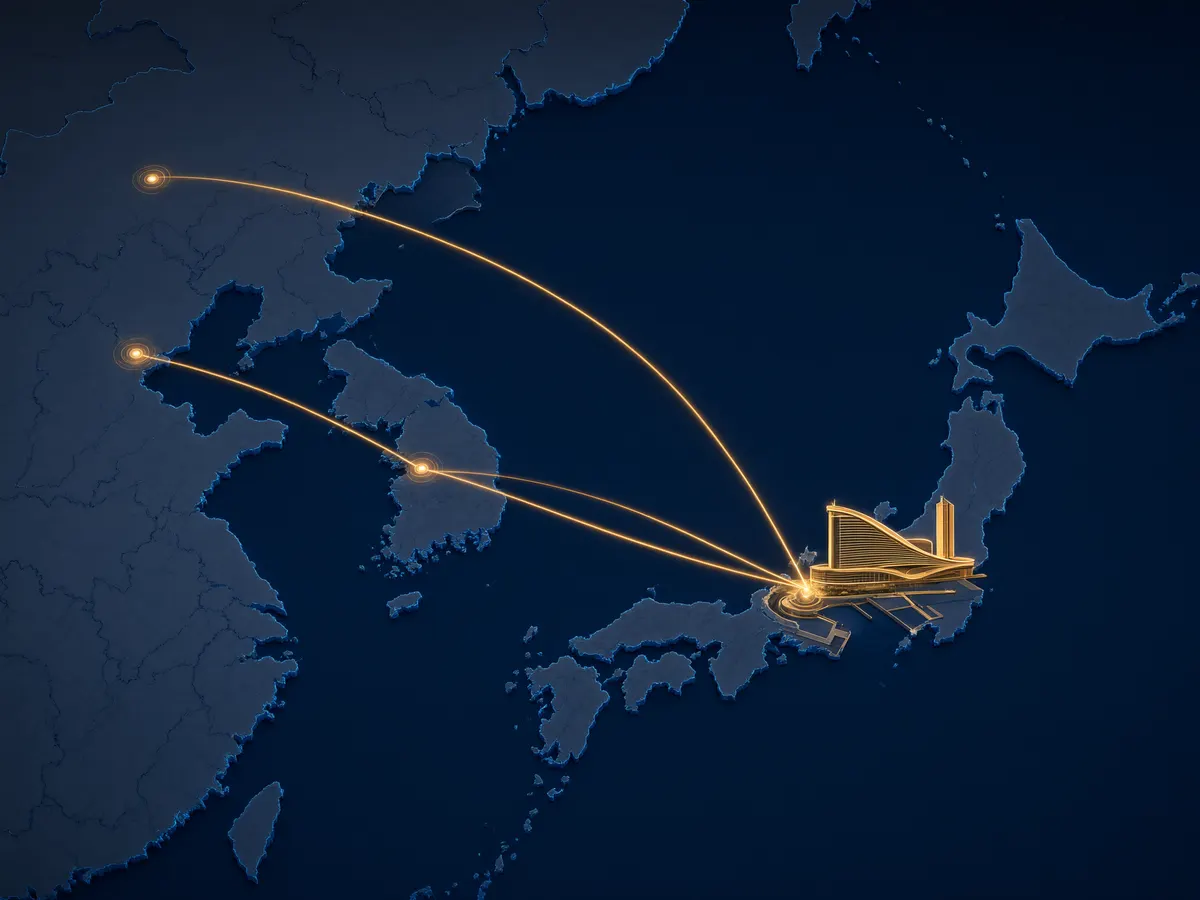
A US$1.72bn ceiling, not a forecast
South Korea’s casinos could lose up to US$1.72 billion in gaming spend once MGM Osaka opens, according to a study reported by industry outlet GGRAsia on 15 October 2026. That single number has become the shorthand for the next phase of Asia casino competition, and it is being repeated with far more confidence than the word “up to” deserves.
Read the headline carefully. It is an upper bound on displaced spend, attached to a property that has not opened, in a market whose visitor mix has been rebuilt twice in the past decade. The trade report carries the figure and the conclusion; it does not hand readers a methodology, a named modelling house, or a year-by-year path. Anyone citing US$1.72bn as a gaming revenue forecast for a specific fiscal year is adding precision the source material never claimed.
That does not make it noise. A ceiling scenario is still useful, because it tells you roughly how much of South Korea’s foreigner-only business a modelling exercise believes is genuinely contestable. The interesting question is not whether Korea loses something. It is which part of the book is at risk, and whether the loss is Osaka’s fault or Korea’s own.
Why MGM Osaka lands inside Korea’s catchment area
MGM Osaka is credible because it is the first and so far only licensed integrated resort in the Japan casino market, built by an MGM Resorts and Orix consortium on Yumeshima, the reclaimed island in Osaka Bay that also hosted Expo 2025. Japan’s government certified the Osaka district development plan in April 2023, with the partners publicly targeting an opening around 2030 and a capital budget reported at about ¥1.27 trillion, roughly US$8.9–10 billion.
Scale matters here in a way it does not in most new-market stories. Nothing in South Korea’s foreigner-only sector was built at IR scale in the Marina Bay Sands or Cotai sense. Paradise City in Incheon is the closest the country has come, and it is a fraction of what the Osaka consortium has described. A property with thousands of hotel rooms, a large convention footprint and a casino floor designed for premium mass volume does not need to poach customers one by one; it changes where tour operators, airlines and premium-mass marketing budgets point.
The other structural advantage is the one Korean operators cannot replicate: Japanese residents may enter. Under Japan’s IR framework, locals pay a ¥6,000 entry fee and are capped at three visits in seven days and ten in 28 days, limits written as a problem-gambling safeguard. Capped access is still access. MGM Osaka will have a domestic base layered under its international traffic. Korea’s foreigner-only venues have no such floor.
Two hours from Seoul, three from Beijing
Osaka sits inside the same short-haul band that Korean casinos have relied on. Flights from Seoul run under two hours, and from Beijing around three. For a Japanese player who currently flies to Incheon or Jeju to gamble, Osaka removes the flight entirely. For a mainland Chinese premium-mass visitor weighing Jeju against Macau, a brand-new Japanese IR becomes a third option at comparable travel cost.
Korea keeps two defences: Jeju’s visa-free entry for many nationalities, and casinos physically inside or beside the hotels where business travellers already sleep. Convenience is a real moat for low-value, high-frequency trips. It is a weak moat for the discretionary trip built around the gambling itself.
The structural problem with South Korea’s casinos
South Korean casinos are exposed because, with one exception, they are legally barred from serving the only customer base that cannot be competed away. Kangwon Land, in a former coal-mining region far from Seoul, is the sole venue admitting Korean nationals. Every other property depends entirely on foreign casino players arriving by air, which means demand is a function of visa policy, airline capacity, diplomatic weather and the attractiveness of alternative destinations.
The sector has already demonstrated how fragile that is. The 2017 THAAD dispute cut Chinese group travel to Korea; the pandemic removed inbound traffic wholesale; the collapse of Macau’s junket market after 2022 reshaped how Asian VIP credit works everywhere, Korea included. Each shock came from outside and none of it could be offset domestically, because there is no domestic market to offset into.
Different access rules across the region’s main markets explain a lot of the competitive asymmetry:
| Market | Local access | Entry cost or limits for residents |
|---|---|---|
| South Korea | Barred, except Kangwon Land | Foreigner-only licensing at all other venues |
| Japan | Permitted at licensed IRs | ¥6,000 entry fee; 3 visits per 7 days, 10 per 28 days |
| Singapore | Permitted | Citizen/PR levy of S$150 per day or S$3,000 per year |
| Macau | Permitted | No entry levy |
| Philippines | Permitted | No entry levy; PAGCOR both regulates and operates |
Paradise Co and Grand Korea Leisure sit on different parts of the risk curve
The two listed names most often cited in any discussion of MGM Osaka impact are Paradise Co and Grand Korea Leisure, and they are not equally exposed. Paradise Co operates Paradise City at Incheon Airport alongside properties in Seoul, Busan and Jeju, and has leaned more heavily on Chinese VIP and premium-mass play. Grand Korea Leisure, the state-linked operator behind the Seven Luck brand in Seoul and Busan, has historically drawn a significant share of its visitation from Japan.
That split is why a blanket percentage applied across the sector is misleading. Osaka subtracts most directly from the Japanese outbound segment, which points at GKL’s mix before Paradise’s. Both companies disclose visitation by nationality, so the actual exposure is checkable rather than a matter of opinion, and anyone sizing this should start there rather than with the headline total. Lotte Tour Development’s Jeju Dream Tower is a third name worth watching, given how concentrated Jeju is on inbound Chinese traffic.
Asia’s hubs have traded share like this before
Every time a regional gaming hub adds major supply, the trade press produces a displacement study, and the outcome has usually been messier than the model. Singapore’s two IRs opened in 2010 and were widely expected to gut Macau’s mass business; Macau kept growing until Beijing’s anti-corruption campaign, not Singapore, broke the VIP cycle. The Philippines built Entertainment City to intercept the same flows and ended up building a largely new local and inbound market, then lost a separate revenue stream entirely when POGO operations were shut down.
The pattern that actually repeats is narrower. New supply tends to grow total regional volume in the mass and premium-mass tiers, because infrastructure and non-gaming amenity pull in people who would not have flown to gamble at all. It redistributes aggressively at the top, because high-value players are mobile, cost-insensitive on travel, and loyal to product and credit rather than geography. Macau’s post-2022 concession renewals, with their non-gaming investment commitments, show regulators now assume the same thing: the defensible business is the one tied to a destination, not to a baccarat table.
Applied to Korea, that reading suggests a loss concentrated in the thinner, higher-value slice of the book, with the mass convenience business more durable than a US$1.72bn figure implies. It also suggests that Osaka’s effect on Jeju could be smaller than its effect on Seoul and Incheon, since Jeju’s visa-free pull is a different product entirely.
What Korean operators can realistically do
Operators have a four-year runway at minimum, and the historical playbook is known. Expect capital expenditure on rooms, entertainment and convention capacity rather than gaming floor, since the floor is not where Korea loses. Expect harder marketing into secondary Asian source markets, including Southeast Asia, where Osaka’s proximity advantage disappears. Expect airline and tour-operator partnerships to be renegotiated well before 2030.
The more consequential lever is regulatory. Operators may renew pressure for flexibility on the foreigner-only rule, or for something narrower, such as expanded premium-mass facilities or easier visa processing. Any move toward broad domestic access would be a major policy reversal in a country that has kept Kangwon Land deliberately remote and deliberately singular, and the political appetite for it has been consistently absent. Lobbying is likely; success is not.
My own reading, weighing both cases: the displacement is real and the structural exposure is worse than the headline suggests, but US$1.72bn is a ceiling that assumes a static Korean product and a Japanese IR that opens on time at full scale. Both assumptions have failure modes. Osaka’s timeline has moved before, and Japan has licensed exactly one IR while Yokohama withdrew and Nagasaki’s bid was rejected, so the second and third Japanese properties that would compound the pressure may simply never arrive.
What the study cannot settle is the thing that matters most to Korean operators: whether Japan’s own residents, newly able to gamble at home under entry caps, turn out to be a market Osaka serves instead of a market it exports. If Japanese demand stays domestic, Korea loses a segment permanently rather than temporarily, and no amount of facility upgrading brings it back. That question will not be answered until the doors open.